
 Date: Sep 02 2025 - 07:18
 Category: Data Lake
 Tags: Data Lake

In today’s digital world, data is constantly being generated from various sources such as social media, online transactions, and IoT devices. As the volume and variety of data continue to grow, traditional data storage and processing methods have become insufficient. This is where data lakes come in – a modern and efficient approach to managing large-scale data.

Simply put, a data lake is a centralized repository that stores all types of raw data in its native format. Unlike a data warehouse, which follows a structured data model, a data lake allows for the storage of both structured and unstructured data.
This means that data from various sources can be easily ingested into a data lake without the need for extensive data transformation or preprocessing.

Data lakes are built on top of a distributed file system, such as Hadoop or Amazon S3, which allows for scalable storage of large amounts of data. The data is stored in its raw form, without any predefined schema or organization.
This makes it easy to store and process data of any type and structure, without the limitations of a traditional database.

1. Flexibility and scalability: Data lakes allow for the storage and processing of any type of data, making it a flexible solution for handling large-scale data. Additionally, as the volume of data grows, data lakes can easily scale to accommodate the increasing data.
2. Cost-effective: With data lakes, there is no need to invest in expensive data warehouses or data transformation processes. The use of a distributed file system also reduces the cost of storage, making it a more cost-effective solution.
3. Real-time data processing: As data is stored in its raw form, data lakes enable real-time processing and analysis of data. This allows for timely decision-making and quick response to changing trends or patterns.
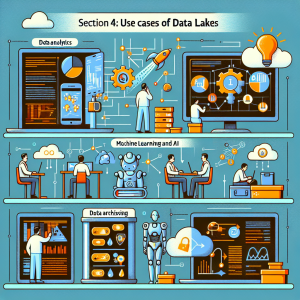
1. Data analytics: Data lakes are a popular choice for storing and processing large amounts of data for analytics purposes. The flexibility and scalability of data lakes make them suitable for handling complex data analytics tasks and providing valuable insights.
2. Machine learning and AI: As data lakes can store both structured and unstructured data, they are a valuable resource for machine learning and AI applications. The raw data can be used to train algorithms and improve their accuracy over time.
3. Data archiving: Data lakes can also serve as a cost-effective solution for long-term data storage. As data lakes can handle large volumes of data, they are suitable for storing historical data that may be needed for future analysis or compliance purposes.

While data lakes offer many benefits, there are also some challenges that come with using them. Some of these include:
1. Data quality: As data lakes store data in its raw form, there is a risk of poor data quality and inconsistencies. Without proper data governance and data quality measures in place, data lakes can become a “data swamp” where it becomes difficult to extract meaningful insights from the data.
2. Data security: As data lakes store large amounts of data, they can become a target for cyber attacks. Proper security measures and access controls must be in place to protect sensitive data stored in a data lake.
3. Data management: As data is stored in its raw form, it can become difficult to manage and maintain a data lake. Without proper organization and metadata management, data lakes can become cluttered and difficult to navigate.
Data lakes are a valuable resource for managing and processing large-scale data. With their flexibility, scalability, and cost-effectiveness, data lakes have become a popular choice for modern data-driven businesses. However, it is important to address the challenges and implement proper data governance and management strategies to make the most out of a data lake. As technology continues to evolve, data lakes will continue to play a crucial role in the storage and management of data.


