 Date: Jul 02 2026 - 12:18
 Category: Artificial Intelligence
 Tags: AI, AI Innovation, AI Training, Artificial Intelligence, Enterprise AI, Generative AI, Large Language Models (LLMs)

Language models have revolutionized the field of Natural Language Processing (NLP) in recent years. With the advent of large-scale pre-trained models such as BERT, GPT-3, and T5, the NLP community has seen a significant improvement in tasks such as text classification, question-answering, and language translation. One particular type of language model that has gained a lot of attention is the Language Model for Legal Documents (LLM).
LLMs are specifically trained on legal text data and have shown promising results in tasks such as contract review and legal document summarization. However, to truly unlock the potential of LLMs, fine-tuning them for industry-specific applications is crucial. In this blog post, we will discuss the importance of fine-tuning LLMs for industry-specific applications and how it can improve the performance of these models.

Before we dive into the world of fine-tuning LLMs, let’s understand what they are. LLMs are large neural networks that are specifically trained on legal text data. These models are trained in an unsupervised manner, meaning they learn patterns and relationships from the input data without any explicit supervision.
LLMs are trained on a massive amount of legal text data, including legal documents, court judgments, and law articles. This extensive training allows LLMs to understand the complexities and nuances of legal language, making them ideal for tasks such as legal document analysis and contract review.
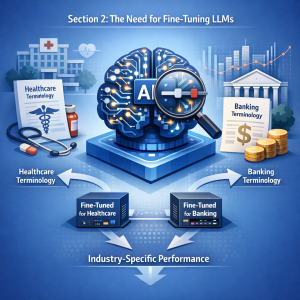
While LLMs are trained on general legal text data, they may not perform well on specific industry-related tasks. For example, a model trained on contract review for the healthcare industry may not perform as well on contract review for the banking industry.
This is because the legal language and terminology used in different industries can vary significantly. Fine-tuning LLMs for specific industries helps the model to learn the specific patterns and language used in that industry, resulting in better performance on industry-specific tasks.
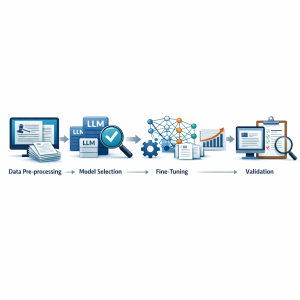
The process of fine-tuning LLMs involves re-training the model on a smaller, industry-specific dataset. This dataset should contain a large number of legal documents from the target industry. The following are the steps involved in fine-tuning LLMs:
1. Data Pre-processing: The legal documents in the dataset need to be pre-processed to remove any irrelevant information and to ensure consistency in formatting.
2. Model Selection: There are several LLMs available, and choosing the right one for the task at hand is crucial. It is essential to consider factors such as the size of the model, the type of training data used, and the task for which the model was originally trained.
3. Fine-tuning: Once the model and dataset are selected, the model is then fine-tuned on the industry-specific dataset. This involves adjusting the model’s parameters to better suit the target industry’s language and terminology.
4. Validation: After the model is fine-tuned, it is essential to validate its performance on a held-out dataset. This dataset should be different from the one used for training and should contain legal documents from the same industry.
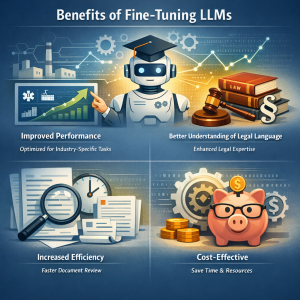
Fine-tuning LLMs for industry-specific applications has several benefits, some of which are discussed below:
1. Improved Performance: By fine-tuning LLMs for specific industries, we can significantly improve their performance on industry-specific tasks. This is because the model learns the specific language and terminology used in the target industry, making it more accurate and efficient.
2. Better Understanding of Legal Language: Fine-tuning LLMs provides a better understanding of legal language in different industries. This can help in creating more accurate and specialized language models for other industries in the future.
3. Increased Efficiency: Fine-tuning LLMs can also increase the efficiency of tasks such as contract review and legal document analysis. With a model trained on industry-specific data, the time and effort required for manual review can be significantly reduced.
4. Cost-Effective: Fine-tuning LLMs can be a cost-effective solution for industries that require specialized language models. Instead of building a model from scratch, fine-tuning a pre-trained LLM can save time and resources.
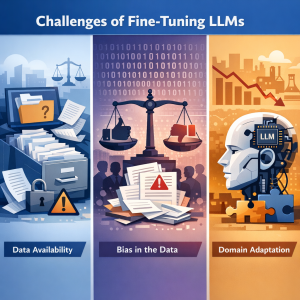
While fine-tuning LLMs has several benefits, it also comes with its own set of challenges. Some of the challenges are:
1. Availability of Data: Fine-tuning LLMs requires a significant amount of industry-specific data. This can be a challenge for industries that do not have a large corpus of legal documents.
2. Bias in the Data: The dataset used for fine-tuning LLMs may contain inherent biases, which can affect the model’s performance. These biases can be due to the nature of the data or the source it was collected from.
3. Domain Adaptation: LLMs may struggle to adapt to a new domain, even after fine-tuning. This can result in lower performance on industry-specific tasks.
Fine-tuning LLMs for industry-specific applications is a crucial step towards unlocking the full potential of these models. It allows them to better understand the complexities and nuances of legal language in different industries, resulting in improved performance on industry-specific tasks.
While there are challenges involved in fine-tuning LLMs, the benefits outweigh them. With the continuous development and advancements in NLP, we can expect to see more specialized and efficient LLMs in the future.