 Date: Jun 05 2026 - 12:35
 Category: Artificial Intelligence
 Tags: AI, Artificial Intelligence, Data Privacy, Deep Learning, Federated Learning

Artificial intelligence (AI) has become an integral part of our lives, from personal assistants like Siri and Alexa to self-driving cars and smart home devices. However, with advancements in AI comes concerns about privacy and data security. As AI algorithms rely heavily on vast amounts of user data, the need for privacy-preserving techniques has become more prevalent.
One such technique that has gained traction in recent years is federated learning. In this blog post, we will explore the concept of federated learning and its role in safeguarding our privacy in the era of AI.
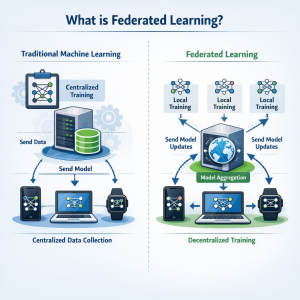
Federated learning is a decentralized machine learning approach that enables multiple devices to collaboratively train a shared model without the need to share their data with a central server. In traditional machine learning, a central server collects and stores data from multiple devices, trains a model using this data, and then distributes the trained model to the devices. This approach poses a risk to user privacy as all their data is stored in one central location.
On the other hand, federated learning distributes the model training process to the devices themselves, eliminating the need to share data with a central server. This is achieved by using a technique called model aggregation, where each device sends its locally trained model to a central server, which then combines these models into a global model. This global model is then sent back to the devices, and the process repeats until the desired level of accuracy is achieved.

Federated learning ensures privacy in two ways. Firstly, by eliminating the need to share data with a central server, it minimizes the risk of a data breach or misuse of personal data. Secondly, federated learning also employs techniques such as differential privacy to further safeguard user data.
Differential privacy is a method that adds noise to the data before sending it to the central server, making it difficult to identify individual data points. This ensures that even if the central server is compromised, the data remains private and cannot be used to identify or track individuals.

Federated learning has several applications in industries where privacy is a top concern. One of the most prominent applications is in the healthcare sector. With the rise of wearable devices and health tracking apps, there is an abundance of personal health data available. However, this data is highly sensitive and needs to be protected. Federated learning allows for the analysis of this data without compromising patient privacy.
Another potential application of federated learning is in the financial sector. With the increasing use of digital payment methods, there is a vast amount of financial data that can be utilized for AI applications. However, this data contains sensitive financial information that needs to be protected. Federated learning allows for the training of AI models using this data without exposing it to a central server, ensuring the privacy of individuals’ financial data.
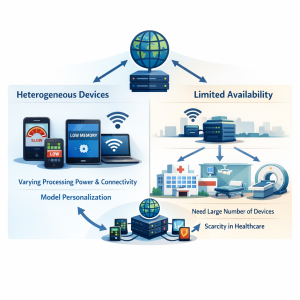
While federated learning offers a promising solution to privacy concerns in AI, it also has its limitations. One of the main challenges is the heterogeneity of devices that participate in the training process. These devices may have varying processing power, memory, and network connectivity, which can affect the accuracy of the global model. To address this, federated learning employs techniques like model personalization, where the global model is customized for each device based on its capabilities.
Another limitation of federated learning is the need for a large number of devices to achieve accurate results. Since each device only has access to a small portion of the data, a large number of devices are required to train a robust model. This can be a challenge in industries where the number of devices available is limited, such as in healthcare.
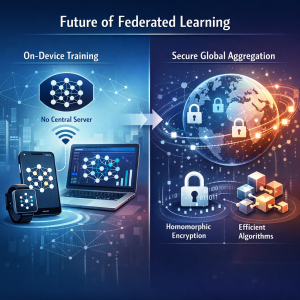
The concept of federated learning is still in its early stages, and there is a lot of research being done to improve its efficiency and effectiveness. One area of research is on-device learning, where the devices themselves train the model without the need for a central server. This eliminates the need for communication with a central server, further enhancing privacy.
Another area of research is on improving the accuracy of the global model while still maintaining privacy. This involves developing more efficient aggregation algorithms and exploring the use of advanced techniques such as homomorphic encryption.
In conclusion, federated learning is a promising technique that addresses the growing concerns about privacy in AI. By decentralizing the model training process and employing techniques such as differential privacy, it ensures that user data remains private and secure.
While there are challenges and limitations, ongoing research in this field is continually improving the effectiveness of federated learning. As AI continues to advance and become more integrated into our lives, techniques like federated learning will play a crucial role in safeguarding our privacy.