 Date: Jun 05 2026 - 12:08
 Category: Artificial Intelligence
 Tags: AI, Artificial Intelligence, Graphneuralnetworks, machinelearning, neuralnetworks
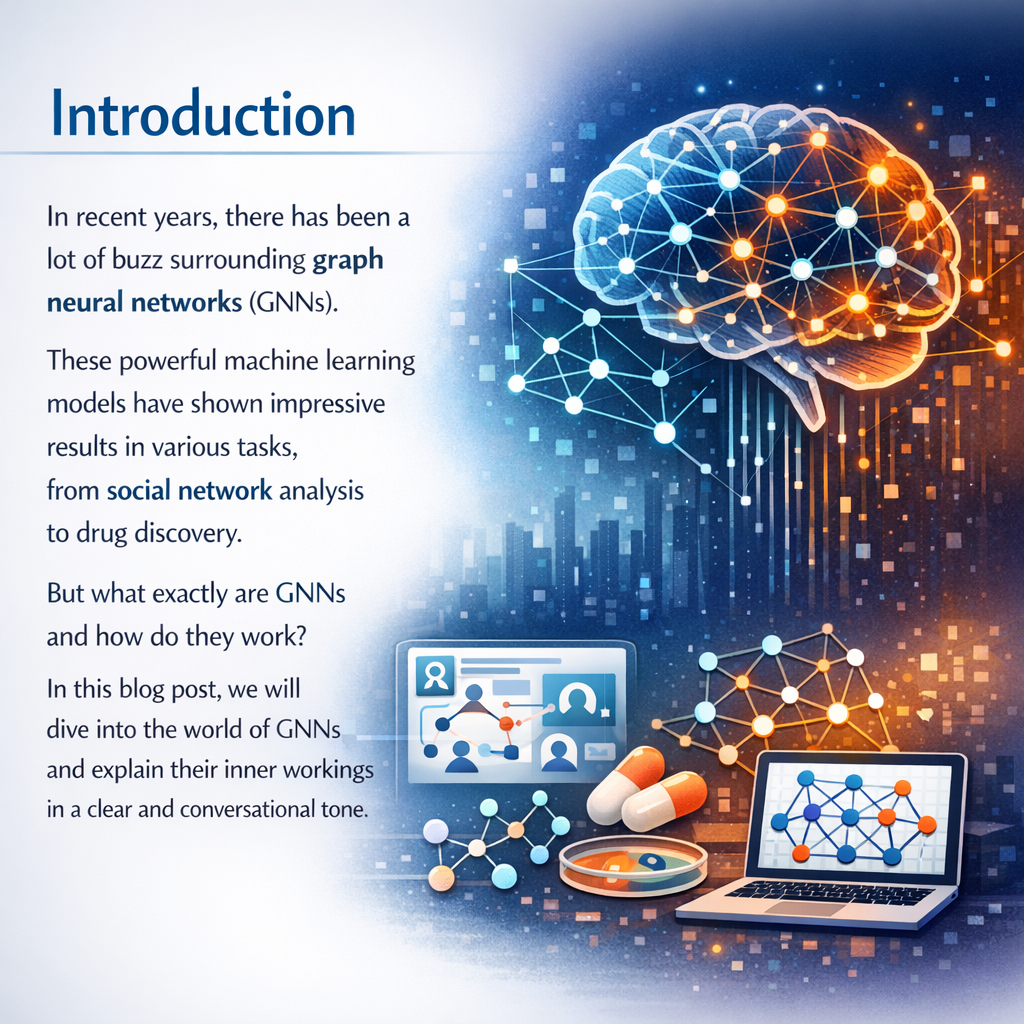
In recent years, there has been a lot of buzz surrounding graph neural networks (GNNs). These powerful machine learning models have shown impressive results in various tasks, from social network analysis to drug discovery. But what exactly are GNNs and how do they work? In this blog post, we will dive into the world of GNNs and explain their inner workings in a clear and conversational tone.
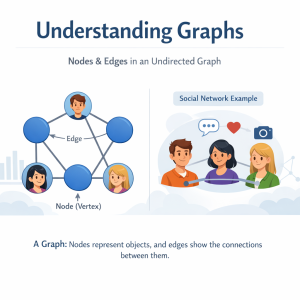
Before we dive into GNNs, let’s first understand what graphs are. In simple terms, a graph is a mathematical structure that represents relationships between objects. It consists of nodes (also known as vertices) and edges connecting these nodes.
Think of a social network, where people are represented as nodes and their connections as edges. This type of data structure is known as an undirected graph, where the edges have no specific direction.
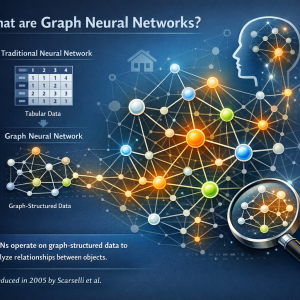
Graph Neural Networks are a type of neural network that can operate on graph-structured data. Unlike traditional neural networks, which operate on tabular data, GNNs can handle data in the form of graphs.
This makes them ideal for tasks that involve analyzing and understanding relationships between objects. GNNs were first introduced in 2005 by Scarselli et al. and have since gained significant attention in the field of machine learning.
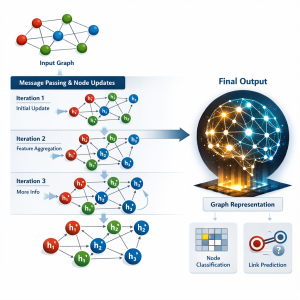
GNNs work by propagating information through the nodes of a graph. They do this in a recursive manner, with each node updating its representation based on its own features and the features of its neighboring nodes. This process is repeated for multiple iterations, allowing the network to gather information from the entire graph.
The final output of the GNN is a representation of the entire graph, which can then be used for downstream tasks such as node classification or link prediction.
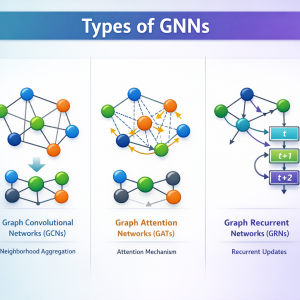
There are several types of GNNs, each with its unique architecture and capabilities. The most common types are Graph Convolutional Networks (GCNs), Graph Attention Networks (GATs), and Graph Recurrent Networks (GRNs). GCNs are the most basic type of GNN, where the node representations are updated by taking into account the features of its neighboring nodes.
GATs, on the other hand, use attention mechanisms to give more weight to important nodes in the graph. GRNs, as the name suggests, use recurrent connections to update node representations, making them suitable for handling sequential data.
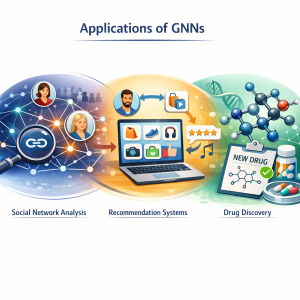
GNNs have shown promising results in various applications, including social network analysis, recommendation systems, and drug discovery. In social network analysis, GNNs can be used to predict links between users or to identify communities within the network.
In recommendation systems, GNNs can be used to make personalized recommendations by learning from the relationships between users and items. In drug discovery, GNNs have been used to predict the efficacy of new drugs by analyzing the chemical structures of molecules.
In conclusion, GNNs are a powerful type of neural network that can operate on graph-structured data. They work by recursively propagating information through the nodes of a graph, allowing them to capture the relationships between objects. With their ability to handle complex and interconnected data, GNNs have shown great potential in various applications. As the field of graph neural networks continues to evolve, we can expect to see even more impressive results in the future.