 Date: May 28 2026 - 11:55
 Category: Artificial Intelligence
 Tags: Large language models, natural language

Large language models, such as GPT-3 and BERT, have revolutionized the field of natural language processing (NLP). These models have achieved impressive results in various language-related tasks, such as text generation, machine translation, and sentiment analysis. However, they are not without flaws. One of the major challenges with large language models is reducing hallucination and improving reasoning.
Hallucination refers to the tendency of these models to generate nonsensical or irrelevant text that is not supported by the input. On the other hand, reasoning refers to the ability of these models to accurately understand and respond to complex questions or prompts. In this blog post, we will explore the technique of prompting and how it can be mastered to reduce hallucination and improve reasoning in large language models.

Before diving into the art of prompting, it is essential to understand what exactly are large language models and how they work. Large language models are deep learning models trained on vast amounts of text data, which enables them to understand and generate human-like language. These models are based on the concept of unsupervised learning, where they learn patterns and relationships in the data without any explicit guidance.
GPT-3, one of the most advanced large language models, has been trained on over 175 billion parameters. This means that it has a vast knowledge of language and can generate text on a wide range of topics. However, this also makes it prone to hallucination and challenges in reasoning.

Prompting is a technique used to guide large language models to generate text or perform a specific task. It involves providing a specific prompt or input to the model, which is then used to produce the desired output. This can be in the form of a few words, a phrase, or a sentence. Prompting can also be used in question-answering tasks, where the model is given a question and prompted to provide a relevant answer.

As mentioned earlier, hallucination is a significant issue with large language models. Prompting can be used to reduce this problem by providing more specific and relevant prompts. By giving the model a specific context to work with, it is less likely to generate irrelevant or nonsensical text. For example, instead of prompting the model with “I went to the store today,” which could result in the model generating irrelevant text, a more specific prompt such as “I went to the store today and bought some groceries” would give the model a clear direction to follow.
Another way to reduce hallucination is by using a technique called “prompt engineering.” This involves designing specific prompts that have been pre-validated to produce high-quality outputs. These prompts are designed based on the data the model has been trained on, and hence, they are more likely to generate accurate and relevant text.
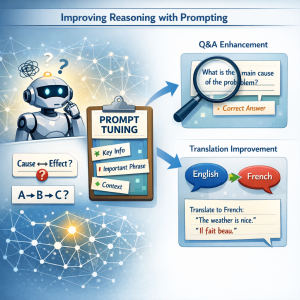
Large language models struggle with complex reasoning tasks, such as understanding cause and effect or performing logical reasoning. With prompting, these models can be guided to focus on the relevant parts of the input and generate more coherent and accurate responses.
One way to improve reasoning with prompting is by using “prompt tuning.” This involves fine-tuning the prompts used for specific tasks to improve the model’s performance. For example, in question-answering tasks, the prompts can be fine-tuned to focus on specific keywords or phrases that are crucial for answering the question accurately.
Prompting can also be used to improve reasoning in language translation tasks. By providing the model with more specific prompts, such as the context of the sentence, the source language, and the target language, it can generate more accurate translations.
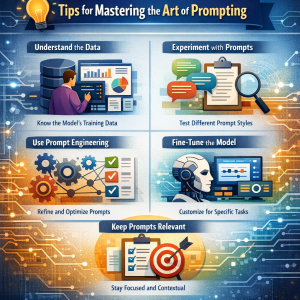
1. Understand the data: Before designing prompts, it is crucial to have a thorough understanding of the data the model has been trained on. This will help in creating relevant and specific prompts that align with the model’s knowledge.
2. Experiment with different prompts: It is essential to experiment with different types of prompts to find the most effective ones for a particular task. This could involve trying out different lengths, sentence structures, or even keywords.
3. Use prompt engineering: As mentioned earlier, prompt engineering can be an effective way to reduce hallucination and improve reasoning. Make use of pre-validated prompts and fine-tune them for your specific task.
4. Fine-tune the model: Along with fine-tuning the prompts, it is also crucial to fine-tune the model itself for specific tasks. This will ensure that the model is optimized for the task at hand.
5. Keep prompts relevant: It is essential to keep prompts relevant to the input and the task. Irrelevant or vague prompts can lead to inaccurate outputs and defeat the purpose of prompting.
In conclusion, prompting is a powerful technique that can help in reducing hallucination and improving reasoning in large language models. By understanding the data, experimenting with different prompts, and fine-tuning the model, we can master the art of prompting and unlock the full potential of these models. As the field of NLP continues to advance, the use of prompting will become increasingly important in achieving more accurate and human-like language generation and understanding.